Head-to-head
Vidalytics vs Vimeo
Pick Vidalytics if you run VSLs or sales videos to paid traffic and want a proven conversion player with per-second retention, heatmaps and sound-first autoplay; pick Vimeo if you need dependable general-purpose hosting for a content library, webinars or brand video, not paid-traffic selling. If you buy media on the actual sale, a dedicated attribution player like TrackPlay ties each play to the cart-verified purchase in a way neither of these does.
Quick answer
Pick Vidalytics if you run VSLs or sales videos to paid traffic and want a proven conversion player with per-second retention, heatmaps and sound-first autoplay; pick Vimeo if you need dependable general-purpose hosting for a content library, webinars or brand video, not paid-traffic selling. If you buy media on the actual sale, a dedicated attribution player like TrackPlay ties each play to the cart-verified purchase in a way neither of these does.
| Vidalytics | Vimeo | |
|---|---|---|
| Best for | Direct response | General hosting |
| From | $19/mo | See vimeo.com |
| Billing | Bandwidth + videos | Subscription |
| Free plan | 3 videos, 50GB | Free tier |
| Sale attribution | Conversion tracking | None |
Where Vidalytics pulls ahead
What works
- Video conversion tracking pins the exact second a viewer converted, and heatmaps plus buyers-versus-non-buyers segments show where attention drops.
- Smart Autoplay falls back to muted autoplay and restarts with sound on the first click, the feature its users credit for the biggest conversion lifts.
- A large, named direct-response user base and years in market give it a track record newer players do not have yet.
What to watch
- Pricing is on bandwidth and video count, so a long VSL on heavy cold traffic can run up overage at about $0.33 a GB.
- Attribution stops at conversion tracking and CRM tags. It does not post the cart-verified sale back to the ad platforms server-side.
What you are actually choosing between
These are not two versions of the same tool. Vidalytics is a conversion player: a video host built for direct-response marketers who run sales videos to paid traffic and judge the player on whether it lifts sales. Vimeo is a general-purpose host and creation suite, built for content libraries, brand video and webinars. Both store your video and play it back cleanly, and past that the overlap thins out fast.
So the useful question is not which is the better host in the abstract. It is what your video has to do. If it sells on a landing page to cold traffic, you want retention analytics and a conversion-first player. If it lives in a library, an about page or a course you sell elsewhere, you want reliable hosting and a clean player. Settle that and most of the choice settles with it.
The player and conversion features
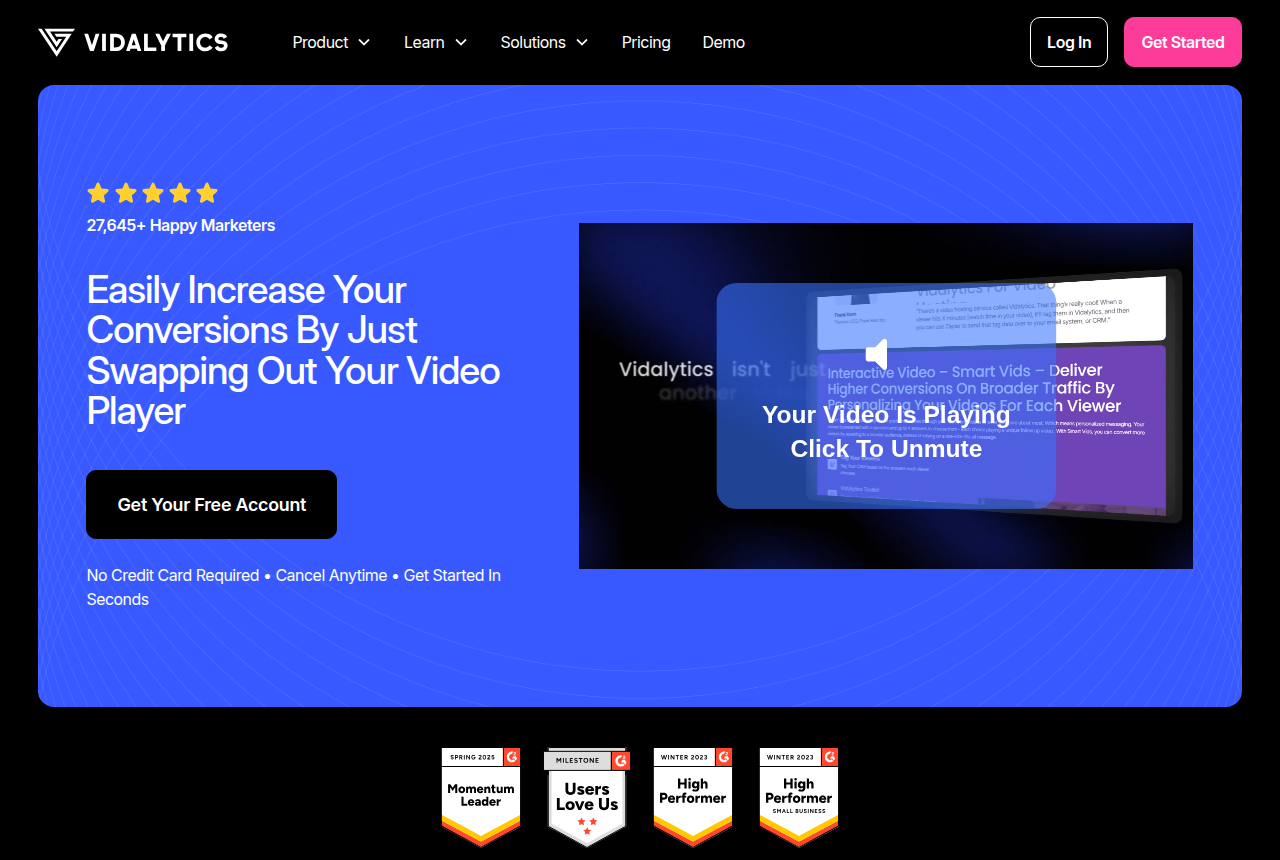
Vidalytics earns its place on sales pages with the player itself. Smart Autoplay starts muted where the browser blocks sound and restarts with sound on the viewer's first click, so the hook is heard from the top. It carries timed CTA buttons, play gates and lead capture, and it has years of use behind it with a large, named direct-response audience. Its users credit that unmute-restart autoplay with the biggest conversion lifts, and the toolset around it is built for one purpose: turning a watch into a sale.
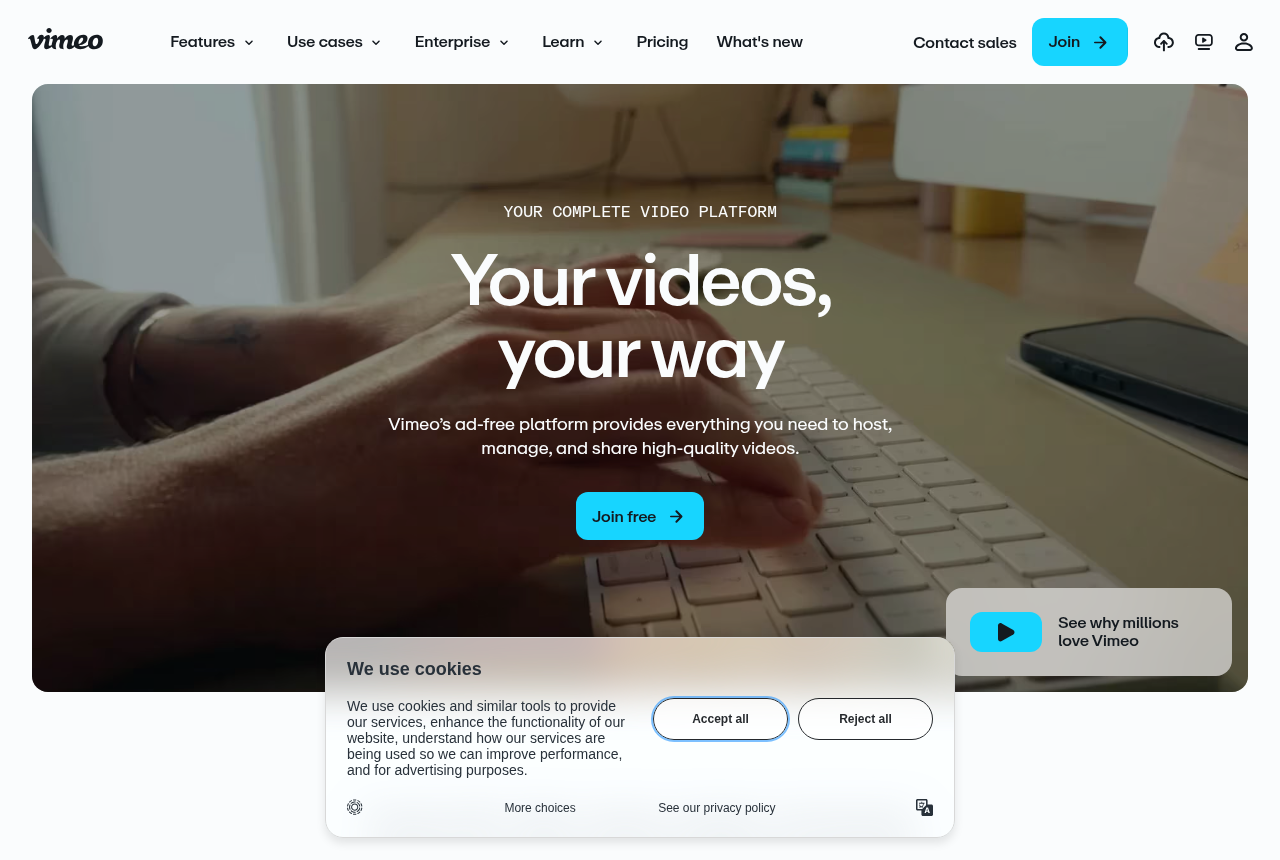
Vimeo's player is polished and dependable, and the product around it is broad: an editor, auto-captions, a video library, live streaming, virtual events and webinar tooling. What it does not carry is a VSL layer. There is no sound-first conversion autoplay, no timed CTA built for a sales page, and no retention view that separates buyers from non-buyers. Those are not omissions Vimeo is trying to fix, because a paid-traffic sales page is not who it serves.
Analytics and attribution
This is where the two tools stop being comparable. Vidalytics pins the exact second a viewer converted, draws heatmaps of where attention holds and drops, and segments watch behaviour by buyers versus non-buyers, so you can see which seconds of a long VSL are dead and cut them. That is a real conversion analytics stack, and it is the reason direct-response marketers pay for it over a general host.
Vimeo reports plays, watch time and engagement. Those are fine numbers for a content library, where the question is whether people watched. They do not answer the question a VSL seller is asking, which is which viewers bought and where the pitch lost the rest. Neither tool, though, closes the last loop: neither posts the cart-verified sale back onto the individual play that earned it and fires that conversion to the ad platform server-side. Vidalytics stops at conversion tracking and CRM tags inside its own dashboard; Vimeo does not attempt attribution at all.
Pricing: plans and bandwidth
Vidalytics bills on bandwidth and video count. There is a Free Forever plan with 3 videos and 50GB, then Starter at $24 a month ($19 billed annually) for 5 videos and 100GB, Pro at $79 a month for 20 videos, and Premium at $149 a month for 50 videos with interactive Smart Vids and the API. Extra bandwidth runs around $0.33 a GB, so a long VSL served to heavy cold traffic can add overage on top of the plan. Read the tier as a floor and count your own bandwidth before you assume it holds. There is a 14-day trial on the paid plans.
One thing worth naming: the analytics that make Vidalytics worth buying are gated. Video conversion tracking and heatmaps require at least the $79 Pro plan, so the Starter tier gives you the player without the conversion data. Budget for Pro if the analytics are the point.
Vimeo sells general subscription tiers. Its pricing page renders its numbers in the browser and returned none to us, so we will not print a figure we did not read on its own page. What matters editorially is what the plans buy: general hosting, a clean player, a library, an editor and webinar tooling, with bandwidth caps that direct-response users regularly report watching. None of that is a VSL conversion toolset. Prices checked September 2026.
Where a dedicated attribution player fits
There is a third option that belongs on this page for one specific reader: the paid-traffic seller who buys media on the sale itself. Vidalytics and Vimeo both stop inside their own dashboard. Vidalytics tracks conversions and tags a CRM; Vimeo reports plays. Neither ties the actual, cart-verified purchase back onto the play that earned it and posts that conversion to the ad platform server-side. That is the job TrackPlay is built for.
TrackPlay is a VSL player and analytics platform for paid-traffic funnels, and attribution is its lead job. When the sale happens, the cart posts the verified purchase back onto the play that earned it, server to server, from seven direct-response carts including ClickBank, ClickFunnels, Kiwify and Digistore24, and TrackPlay fires that conversion server-side to Meta, TikTok and GA4 on the watch-time milestone you choose, deduping the browser and server events. Around that it runs the same class of player as Vidalytics, with sound-first autoplay and timed CTAs, and it draws per-second retention split into buyers and non-buyers alongside revenue per play, hook rate and hold rate. Its split tests are decided on the cart-verified sale with real statistics rather than clicks, with variants running under one embed so the ad links never reset. It bills on plays rather than bandwidth, every feature ships on every paid plan, and there is a free plan of 1,000 plays a month with no card, plus a 14-day trial of the paid features, with paid plans from $29 a month.
It is narrow by design. It is built for paid-traffic VSL conversion, not general hosting or a B2B content library, so it has none of the channels, SEO pages or webinar tooling of a Wistia, and it is a poor fit if the video's job is content marketing rather than a direct-response sale. That narrowness is the trade that buys the sale-level attribution in the first place, and for a cold-traffic VSL you still get the full player, the buyers-versus-non-buyers retention and the postbacks it is built around. It is also very new, with little third-party review footprint yet and invite-only signup, so you cannot lean on outside proof before you commit paid traffic. That is what you would expect of a platform this recent, and the free plan lets you judge it on your own numbers first.
Which one for you
Pick Vidalytics if you run VSLs or sales videos to paid traffic and want a proven conversion player. Its per-second retention, heatmaps, buyers-versus-non-buyers segments and sound-first autoplay are aimed squarely at lifting sales, and its long track record and named user base are reassurance a newer tool cannot offer yet. Just budget for the Pro plan, because the conversion analytics live there.
Pick Vimeo if the video's job is a content library, an about page, a webinar or brand video rather than a paid-traffic sale. Its player and creation suite are dependable and broad, and none of Vidalytics's selling features earn their keep when there is nothing to sell on the page.
Pick a dedicated attribution player like TrackPlay if you run cold paid traffic to a VSL and buy media on the sale. When you need the cart-verified conversion posted back to Meta, TikTok and GA4 server-side, and retention split by who actually bought, it does a job neither Vidalytics nor Vimeo attempts. If your video is not a direct-response sale, it is not the tool, and one of the other two is the better call.
Our pick
Vidalytics
Vidalytics is the pick if you want a proven direct-response player with deep conversion analytics and can live with bandwidth-based pricing.
Frequently asked questions
Is Vidalytics or Vimeo better for a VSL?
How much does Vidalytics cost, and what does Vimeo cost?
Does Vidalytics gate its best analytics behind higher plans?
Does either one post the sale back to Meta or TikTok?
Sources
The vendors' own pages
Other sources
Related reading

Written by
Mara Vance
Editor
Mara edits the reviews and roundups on VSL Host Report. She looks at how a video player behaves on cold paid traffic: autoplay and unmute behaviour, per-second retention, timed CTAs, lead gates and load speed. She also maps what each host really costs, whether it bills per play, per gigabyte or per seat, and rebuilds the monthly bill for a typical VSL funnel. For each piece she reads long-term user reports across forums and review sites, works through the vendor's own docs and pricing, and confirms the numbers before a verdict goes live.
Last checked 2026-09-29